eegBY REDGOLDExplore the system ↗

THE BRAIN-INTERFACE PROJECT

A closer look
at your signals.

A modular approach to brain-signal acquisition. Thoughtful contact mechanics on the head. Accessible electronics on the body. A signal path you can follow.

Research hardware concept. No assembled performance, clinical benefit or diagnostic capability is established.

SPATIAL DESIGN STUDYDRAG TO ROTATE
Contact and wiring placement study. The translucent head is a reference surface; the 32 shown contacts illustrate the upper baseline count, not a fixed clinical montage or a finished helmet.Contact and wiring placement study. The translucent head is a reference surface; the 32 shown contacts illustrate the upper baseline count, not a fixed clinical montage or a finished helmet.
Contact and wiring placement study. The translucent head is a reference surface; the 32 shown contacts illustrate the upper baseline count, not a fixed clinical montage or a finished helmet.
16–32dry pneumatic contacts
in the helmet baseline
70 × 70 mmapproximate IronBCI-32 board
before its protective enclosure
500 Hz/chprovisional acquisition baseline
requires unit-level confirmation

Understand the signal.
Respect the uncertainty.Design intentions and planning values.
Not complete-system ratings.

THOUGHT IN EVERY INTERFACE

Better contact.
A clearer architecture.

Small scalp signals deserve deliberate mechanics, a defined reference and a carefully controlled path to the recorder.

The garment baseline uses passive dry-contact modules in a removable helmet liner. Pneumatic preload and individual flexures accommodate fit. A detachable shielded loom runs to a forearm-mounted IronBCI-32 board, keeping acquisition electronics out of the helmet.

THE ARCHITECTURE, OPENED UP

From contact
to context.

The conventional acquisition baseline stays separate from experimental optical links and other sensing modalities.

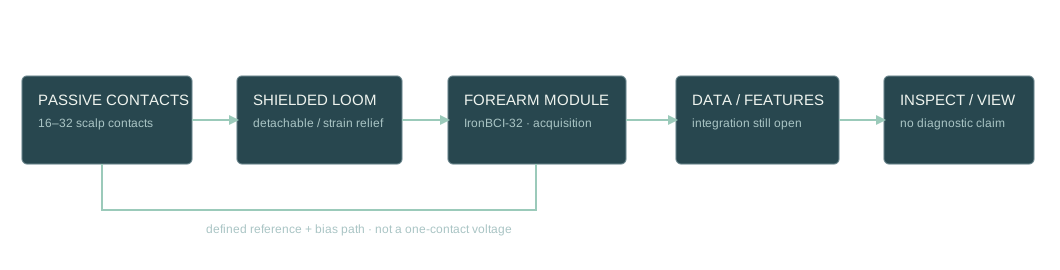
eeg functional architectureConventional baseline: contact voltage is measured relative to a reference, with a separate bias path as needed. The signal illustration is explanatory; no live or recorded human EEG is displayed.PASSIVE CONTACTS16–32 scalp contactsSHIELDED LOOMdetachable / strain reliefFOREARM MODULEIronBCI-32 · acquisitionDATA / FEATURESintegration still openINSPECT / VIEWno diagnostic claimdefined reference + bias path · not a one-contact voltage

Conventional baseline: contact voltage is measured relative to a reference, with a separate bias path as needed. The signal illustration is explanatory; no live or recorded human EEG is displayed.

Start with the interface.

Sixteen to thirty-two dry contacts sit in removable, pneumatically preloaded cassettes. Helmet structure supplies the reaction force; local flexures accommodate surface variation.

The illustration shows a possible distribution, not a selected medical electrode montage.

MADE CONCRETE

Look closer.
The details matter.

Reference dimensions and proposed interfaces make the concept tangible. Full packaging remains part of the design work.

CONTACT MODULE

20–30 mm planform

Micro-bladder target: 1.0–1.5 mm collapsed, 2–3 mm inflated. Compliant flexure: 0.5–1.0 mm. These are analytical packaging targets.

REPLACEABLE SURFACE

8–12 mm face

A flat face suits hairless skin; short rounded 2–4 mm petals/pins are explored for hair-bearing scalp. Force, impedance and comfort remain to be characterized.

BODY ELECTRONICS

14–17 mm enclosure depth

Estimated protective depth for the approximately 70 × 70 mm board, before a battery allowance. The acquisition module is on the forearm.

OPEN ABOUT WHAT GOES INTO IT

A useful budget starts
with the exact hardware.

USD component references, historical source snapshots and clearly visible gaps.

IronBCI-32 & protective enclosureUnpriced
Exact configuration to confirm

One forearm board, enclosure and connectors. Board availability, channel behavior, noise, power and software support are not assumed from a name.

16–32 pneumatic contact cassettesUnpriced
Fabrication design target

Silver/AgCl contacts, small bladders, flexures, force stops, pressure ports and removable liner interfaces.

Reference, bias & shielded loomUnpriced
Integration work

Detachable wiring, strain relief, protected connectors and defined signal reference. Shielding is not automatically the reference electrode.

Pneumatic supply & controlUnpriced
Integration work

Supply, regulation, restrictors and pressure measurement compatible with contact-force limits.

Four-channel analog fiber experimentUnpriced
Separate experimental lane

OPA376 buffers, feedback-controlled LED channels, one 1 mm plastic fiber per channel and remote photodiode receivers. Not added to the conventional baseline.

fNIRS / magnetometry researchUnpriced
Independent research scope

Additional physiology and magnetic sensing have distinct hardware, noise and interpretation requirements; neither is included in the EEG baseline.

Download component references ↓

THE QUESTIONS WORTH ASKING

Behind
the concept.

What is the actual device being proposed?

The selected garment baseline is a passive dry-contact helmet liner connected by a detachable shielded loom to an IronBCI-32 acquisition board on the forearm. The board is approximately 70 × 70 mm. This page depicts that architecture, not an imagined standalone wireless headband.

Can it read thoughts or diagnose a condition?

No such capability is established. EEG records small voltage differences influenced by neural activity and many artifacts. Contact quality, movement, muscles, eye motion and the electronics all affect the recording. Diagnostic, cognitive-enhancement and clinical-outcome claims would exceed the evidence.

Is the optical link part of the baseline?

No. The four-channel analog optical experiment buffers each contact, controls an LED with a local monitor-photodiode servo, carries light through one fiber per channel and recovers it at a remote receiver. It remains a separate experiment with its own calibration and noise questions.

What software exists already?

The repository preserves a Rust Muse 2 BLE client, feature extraction, streaming server and WebSocket viewer. That software foundation does not by itself support the proposed IronBCI board or establish a validated closed-loop neurofeedback application.

THOUGHTFULLY DESIGNED. OPENLY EXPLAINED.

A better interface
starts with understanding.

Explore the assembly ↑